
Is CBD legal in the UK in 2026? As of 3 September 2026, the answer just got a lot clearer. The Food Standards Agency (FSA) did something it has never done before: it recommended full authorisation for three CBD products as “novel foods.” It sounds technical, but it’s arguably the biggest regulatory shift the UK CBD industry has seen since CBD went mainstream. If you buy CBD oil, flowers, vapes or hash in the UK, here’s exactly what changed, what it means for you, and how the picture looks across the border in Ireland.
What just happened: the FSA’s first-ever CBD novel food recommendation
For years, CBD has existed in a strange grey area of UK food law. Thousands of products have been sold under “enforcement discretion” — tolerated by regulators while their safety was assessed, but never formally approved. That changed on 3 September 2026, when the FSA published its recommendation to authorise three CBD products as novel foods for the first time:
- Chanelle McCoy CBD Ltd — synthetic CBD
- Cannaray Brands Ltd — CBD isolate, also permitted in beverages and confectionery
- EIHA Projects GmbH — hemp-derived CBD isolate
All three contain at least 98% pure CBD and have passed the FSA’s safety assessment. The FSA’s board reviews the recommendation on 16 September 2026, before it’s passed to ministers in England and Wales for a final decision, expected this autumn.
It’s a bigger deal than three products might suggest. Around 3,000 existing CBD products currently sitting on the FSA’s Public List could be linked to these applications if they’re approved, effectively giving the wider market its first real route to full legal compliance. And it may not stop there — 14 further applications have already received positive safety opinions, so more authorisations are likely to follow.
Is CBD Legal in the UK, or Just Tolerated? Novel Food vs Controlled Substance
This is where a lot of confusion comes from, so let’s untangle it.
CBD’s legal status as a substance has been settled for a while: hemp-derived CBD products are legal to buy and sell in the UK provided they contain less than 0.2% THC by concentration, or no more than 1mg of THC per container — the Home Office’s current threshold under the Misuse of Drugs Act. This is why CBD oils, flowers, hash and vapes have been available in shops and online for years.
The novel food process is a separate track entirely. It’s not about whether CBD is a controlled drug — it’s about food safety. Under UK and EU food law, any ingredient without a significant history of consumption before 1997 needs formal safety authorisation before it can be sold long-term as a food or supplement. CBD falls into that category, so every CBD food product has technically needed novel food authorisation since 2020. In practice, the FSA allowed the market to keep trading on its Public List while assessments were carried out — but until 3 September 2026, not a single product had made it all the way through to full approval.
So nothing changes about whether CBD is legal to sell. What changes is that, for the first time, specific products are on track to be officially recognised as safe for long-term sale — a milestone the FSA itself has called “a major milestone in the regulation of the CBD food sector.”
What this means if you buy CBD in the UK
For everyday shoppers, this is good news, mostly in the form of reassurance:
- More certainty, less grey area — products linked to an authorised novel food application will have a formal safety stamp, rather than sitting on a provisional list.
- Clearer labelling — the FSA’s guidance sets a recommended safe intake of 10mg of CBD per day for adults, and products will need warning labels for anyone under 18, pregnant or breastfeeding, on medication, or immunocompromised.
- A stronger case for buying from compliant retailers — with the market moving toward real accountability, it matters more than ever to buy from sellers who lab-test their products and stay on top of FSA guidance, rather than the cheapest listing you can find.
At Iguana Smoke UK, our CBD flowers, hash, vapes and other products are lab-tested and formulated with current UK thresholds in mind, so you don’t have to second-guess what you’re buying.
This is general information, not medical advice. If you’re pregnant, breastfeeding, taking medication, or have a health condition, speak to a doctor before using CBD.
Current THC limits for legal CBD in the UK (2026)
To be sold legally in the UK right now, a CBD product needs to fall under one of these thresholds:
- Less than 0.2% THC by concentration, or
- No more than 1mg of THC per container (the Home Office’s practical threshold)
Because extracting 100% pure CBD is virtually impossible, products like CBD flower and hash will always contain trace, non-intoxicating levels of THC and other cannabinoids — which is exactly why these thresholds exist: to draw a clear, workable line between legal hemp products and controlled cannabis.
Worth watching: the FSA has also signalled it may move toward a “zero detectable THC” standard in future, using advanced lab testing methods, following an industry consultation. Nothing has changed yet, but it’s a space to keep an eye on if you sell or buy CBD regularly.
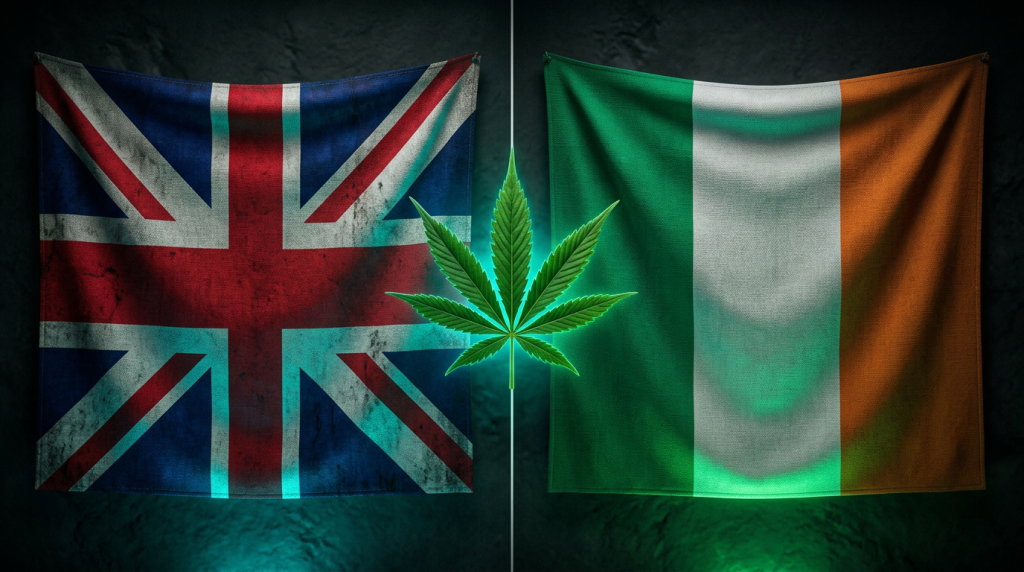
What about Ireland? CBD legal status compared
If you’re shopping from Ireland, the rules are noticeably stricter than in the UK, so it’s worth knowing the difference before you order.
- THC limit — Ireland follows the EU’s 0.2% THC threshold at the hemp cultivation stage, but a 2022 High Court ruling requires the final product to contain no detectable THC at all, a much stricter bar than the UK’s.
- What’s legal — CBD oils, isolates, capsules and CBD-infused skincare made from compliant hemp.
- What’s not legal — raw CBD flower and CBD hash remain treated as cannabis under Irish law, regardless of THC content, so they can’t be legally sold or shipped into Ireland the way they can in the UK.
- No medical claims — the Health Products Regulatory Authority (HPRA) does not recognise CBD as a medicinal product, so it can only be marketed and sold as a food supplement, never with health or treatment claims.
In short: UK and Irish shoppers are not shopping under the same rules, even though both markets sell “CBD.” If you’re ordering from Ireland, oils, capsules and topicals are your safest bet; flower and hash fall outside what’s currently permitted.
What happens next
Here’s the timeline to watch over the next few months:
- 16 September 2026 — the FSA board formally reviews the novel food recommendation.
- Autumn 2026 — ministers in England and Wales are expected to make the final authorisation decision.
- Ongoing — a further 14 applications with positive safety opinions could follow the same path, gradually bringing more of the ~3,000 products on the Public List into full compliance.
- Four-nations alignment — Scotland is running its own consultation through Food Standards Scotland, so full UK-wide alignment may take a little longer to land.
Until the dust settles, the safest move as a shopper is the one that’s always been true: buy from retailers who lab-test their products, stay within the legal THC thresholds, and keep up with FSA guidance — rather than chasing whoever is cheapest.
FAQs
Yes. CBD products containing less than 0.2% THC (or under 1mg THC per container) have been legal to buy and sell for years. What’s new is that specific products are now on track for full novel food authorisation — a food-safety approval, not a change to CBD’s legal status.
It’s the UK’s official safety-approval route for foods and supplements without a long history of consumption, including CBD. Products can be sold while under assessment (on the FSA’s Public List), but full authorisation is the final, formal stamp of approval.
FSA guidance recommends adults do not exceed 10mg of CBD per day, unless advised otherwise by a healthcare professional.
Yes, but under stricter rules than the UK. Final products must contain no detectable THC, and only oils, isolates, capsules and topicals are permitted — raw CBD flower and hash are not legal in Ireland.
Look for retailers who publish lab reports and stay within current THC thresholds. Iguana Smoke UK’s full range of CBD flowers, hash, vapes and more is lab-tested and compliant with current UK regulations.
Sources: Food Standards Agency, The Marijuana Herald, Business of Cannabis, Essentia Pura, Releaf UK.